The aftercare you plan for face contouring injection should cover a few days of watching how your face responds, a clear way to reach the clinic, and a travel schedule that leaves room for a check if you need one. At Miri Clinic in Gangdong, Seoul, the clinic describes an aftercare process built around symptoms that can follow a procedure, with guidance on the recovery course. This article looks only at that aftercare question for visitors from abroad. For the treatment itself, see the clinic's page on Face contouring injection, and for a broader overview read What Should Visitors Know About Face Contouring Injection?
Why does aftercare matter more when you are travelling?
Aftercare matters more when you travel because the days after an injection are when you are most likely to notice changes, and you may be far from the clinic when they appear. Planning ahead means you know whom to contact and what to watch for before you board a flight. Your doctor explains what is expected for you at consultation, because responses differ from person to person.
Face contouring injection is a minimally invasive approach to shaping the lower face, and injection-based treatments of this kind put a needle through the skin. Any procedure that breaks the skin carries some chance of local reactions. Published literature has reviewed infections caused by nontuberculous mycobacteria after injection lipolysis, which is used for body and face contouring, and it identifies these infections as complications that can affect how the technique is used clinically. That is not a reason to assume a problem will happen. It is a reason to take unusual symptoms seriously and report them early.
The clinic's own materials say its approach favours natural-looking change and avoids excess, and that the doctor decides direction only after consultation and checking. Aftercare fits the same pattern: it is explained to you in person, based on your face and your plan, rather than handed over as a fixed script.
What should I watch for in the days after treatment?
In the days after a face contouring injection, watch the treated area for changes in how it looks and feels, and note anything that seems to be getting worse rather than settling. Mild, short-lived reactions at the injection points are a common type of response to injections in general. Anything that is persistent, spreading or clearly worsening is worth reporting to the clinic rather than waiting out.
A practical way to keep track is a short list you check each day:
- Swelling or puffiness that grows instead of easing.
- Redness, warmth or tenderness that spreads beyond the treated area.
- Firm lumps, nodules or discharge at an injection point.
- Fever or a general feeling of being unwell.
- Any change you were not told to expect at your consultation.
Some skin changes can also show up later than the first days, so a good question for your doctor is how long you should keep watching the area after you leave. The clinic's materials do not state a specific monitoring period, so ask at consultation rather than assuming one.
Taking dated photographs of the area with your phone can help you describe changes accurately if you need to message the clinic from home. Keep them for your own reference and for any later doctor you see.
How should I schedule the trip around the clinic's hours?
Schedule the trip so that your treatment is not on your last day in Korea, and so that at least one clinic opening day remains afterwards in case you want to be seen. The clinic is open Monday, Wednesday and Friday from 10:00 to 19:00, Tuesday from 10:00 to 20:00, Thursday from 14:30 to 20:00 and Saturday from 10:00 to 15:00. It is closed on Sundays and public holidays, and lunch is from 13:00 to 14:00 except on Saturdays.
Those hours shape the plan in a few simple ways:
- Thursday opens only in the afternoon, so a Thursday morning check is not possible.
- Saturday closes at 15:00, so a Saturday treatment leaves no same-weekend follow-up, because the clinic is closed on Sunday.
- Public holidays in Korea can close the clinic, so check the calendar for your travel dates.
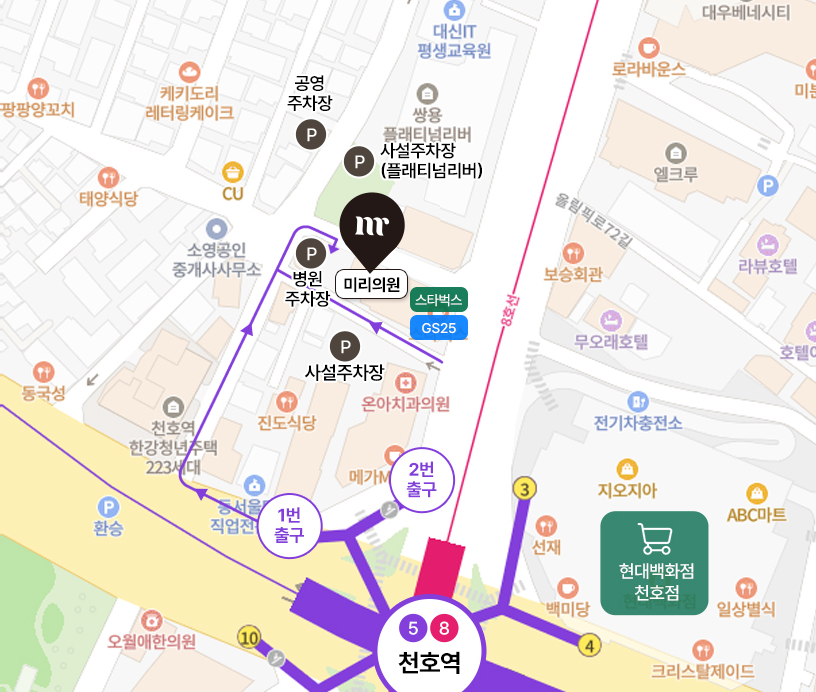
The clinic is in Gangdong, Seoul, in a building in front of exit 2 of Cheonho Station, which is helpful to know if you are staying nearby and want a short trip back. You can confirm the address and hours on the Location & Hours page.
Also think about the flight itself. Whether and when to travel after an injection treatment is a question for your doctor, because it depends on how your face responds and on the treatment plan. Ask this before you book your return ticket, not after.
What should I ask before I leave the clinic?
Before you leave the clinic, ask what normal recovery looks like for you, which signs mean you should make contact, and how to reach the clinic from abroad. Your doctor can tailor the answers to your skin, your plan and your travel dates. Write the answers down, since instructions are easier to follow from a note than from memory.
A useful set of questions:
- What changes are expected in the first days, and which are not?
- For how long should I keep watching the area?
- Which symptoms should make me contact the clinic, and which should make me see a local doctor right away?
- How do I reach the clinic after I leave Korea? The clinic lists a phone number, 02-470-1175, and KakaoTalk and Naver channels in its materials.
- Is a follow-up visit advisable before I fly, and if so, when does the clinic's schedule allow it?
- What should I tell a doctor at home if I need care there, including the name of the procedure I had?
Costs are not covered here. Please ask the clinic about pricing at your consultation, including for any follow-up visit.
What if a problem appears after I am home?
If a problem appears after you are home, contact the clinic with your dated photographs and a short description, and see a local doctor promptly if symptoms are worsening or you feel unwell. Do not wait for a reply if something seems urgent. A local doctor can examine you in person, which a message cannot replace.
When you see a local doctor, tell them that you had an injection treatment for face contouring, where it was done and roughly when. Telling a local doctor about your earlier treatment helps them assess your symptoms and decide what to check.
Results and recovery differ from person to person, and no plan removes every uncertainty. The aim of aftercare planning is simply to make sure you are never guessing about what to do next. To arrange a consultation, you can use the clinic's Online Booking page.
 Naver Map
 KakaoMap
 Miri Clinic Blog