International patients should know that red acne marks and visible pores are two different skin concerns that are often looked at together, and that what suits you is decided by examining your skin in person rather than from a fixed menu. Miri Clinic in Gangdong, Seoul lists "Red acne marks & pores" as its own treatment area, and this article explains how to think about the two concerns and what to bring up at a first visit.
Why are red marks and pores discussed together?
Red acne marks are the reddish areas that can remain on the skin after a breakout has settled. Pores are the small openings around hair follicles, and they can look more noticeable on some parts of the face, such as the cheeks and the sides of the nose. Both are commonly linked to a history of breakouts, which is why they sit under one heading. They are still different problems. A red mark is mainly about colour and the look of the skin surface after inflammation, while a pore concern is about the texture and structure of the skin around a follicle. A good assessment separates the two so that the discussion stays focused on what you actually want to change.
What equipment does the clinic list?
The clinic's equipment list includes 10THERMA, Doublo Gold, Ultherapy PRIME, RevLite SI (toning) and LDM. The clinic does not present these as a set package for red marks and pores, and the source material does not assign a specific purpose to each device, so this article does not either. What matters for you is that the choice of any device, or of no device at all, is made by the doctor after looking at your skin. Suitability, results and recovery differ from person to person, and none of this is a promise of a particular outcome.
What should I tell the doctor about my marks and pores?
Because the two concerns are separate, it helps to arrive with clear answers to a few questions:
- Which bothers you more, the colour of the marks or the look of the pores?
- Where on the face do you notice them most?
- How long have they been there, and have they changed recently?
- Which skincare products or treatments have you used so far?
- Does your skin react easily to new products?
Photos of your skin in ordinary lighting can help you describe what you see, though the doctor will still examine your skin directly. Being specific about your priorities lets the consultation spend its time on the concern that matters most to you.

What is different for a visitor from abroad?
Skin is assessed in person, so it is sensible to treat a first visit as a consultation and not to assume a treatment will take place that day. Your doctor will explain what is suitable, how the plan might be spaced, and what to expect afterwards. If your stay in Korea is limited, say so at the start, since the length of your trip can affect which options are practical and how any follow-up would be arranged. Ask about this directly instead of assuming a schedule.
It is also worth asking how your skin should be looked after between visits and what to watch for once you are back home, so that you leave with a plan you can follow. Costs are not listed here; ask us for pricing, and the clinic will explain costs at consultation.
Where is the clinic and when is it open?
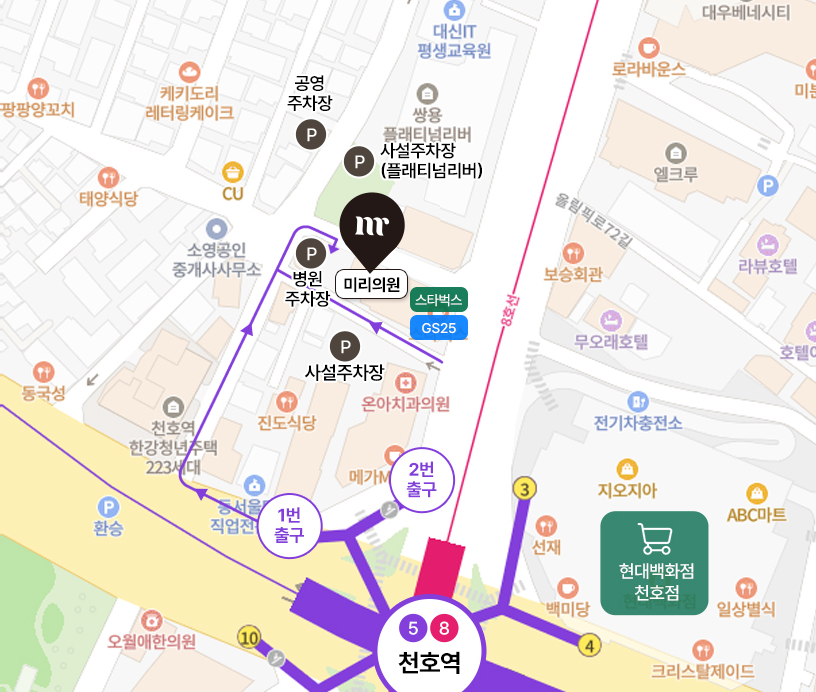
The clinic is in Cheonho-dong, Gangdong-gu, Seoul, directly in front of Exit 2 of Cheonho Station. Hours are Monday, Wednesday and Friday 10:00 to 19:00, Tuesday 10:00 to 20:00, Thursday 14:30 to 20:00 and Saturday 10:00 to 15:00. The clinic is closed on Sundays and public holidays, and the lunch break is 13:00 to 14:00 except on Saturday. You can read more about this treatment area on the clinic's page Red acne marks & pores. To plan a visit, call 02-470-1175.
 Naver Map
 KakaoMap
 Miri Clinic Blog